


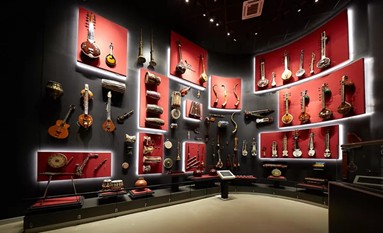
Bengaluru has lately been known for its wide plethora of museums that, instead of following the conventional methods, allow visitors to see, hear, and feel the arts. Be it the Museum of Art and Photography or the NIMHANS Brain Museum, Bengaluru, the museums of Bengaluru have stepped up to not only teach the people of Bangalore, but also immerse them in the experience. And one such museum is the Indian Music Experience Museum (IME Museum). The IME Museum is not only an exhibit of the history and varieties of Indian music and its culture, but rather a vessel that takes one on a journey of Indian music and its evolution throughout the years.
Flow of the museum/music
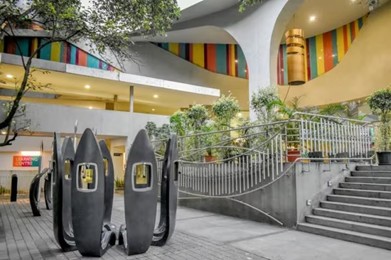
One of the biggest reasons for the IME Museum standing out is the building itself. Rather than creating a structure like any other building, with a clear direction and rigid boxes for rooms, the museum is built more freely, with one room flowing into the other, with different levels of the building spiraling into one another. While the inspiration for the structure is taken from the anatomy of a tree, the building itself moves like music, ebbing and flowing from one room to another, allowing the viewers to move as they please, spontaneously, just like a musical note or raga.
The galleries of music
As soon as you enter the premises, you will be greeted by the sound garden, which features several large-scale musical sculptures that also double as instruments. As you walk around the garden, you are free to explore these sculptures, listen to the sounds they make, and play with them, turning it into a fully tactile experience. As you enter the museum, you will explore an array of galleries. The nine galleries in total are named Contemporary Expressions, Living Traditions, Devotional Music, Songs of People, Melting Pot, Instruments Gallery, Songs of Struggle, Reaching Out, and finally The Star (Hall of Fame).
The harmony between the traditional and the modern
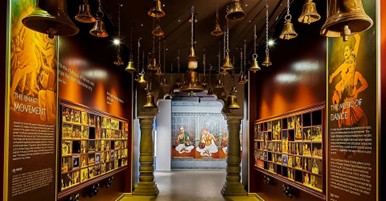
Each gallery provides a different insight into how music is made, defined, inspired, and evolved. The museum does not just target one’s nostalgia for classical and devotional music, but rather takes you on a journey to show you how they have evolved into more modern iterations. It highlights how even the music that we listen to today, whether it be Bollywood, electronic music, or Indian punk, carries influences and pieces of classical Indian music. The museum does not villainize modern music as a debauchery of the classics, it allows the two to exist together in one space, right next to each other in complete harmony.
The Indian Music Experience Museum is not just another boring museum, but rather an innovative, immersive experience that takes one through the intricate and soulful journey music has taken in the Indian subcontinent throughout centuries. It shows that music is never one-dimensional, but something that is alive, ever-changing, and ever-evolving. More than anything, it is a love letter to the landscape of Indian music.
Author