




In a city where intellect hums beneath the surface and ambition shapes the horizon, a new kind of ritual is taking root. It whispers rather than shouts, and gathers meaning in candlelit rooms rather than crowded halls. Bengaluru’s residents have begun seeking experiences that engage not just the senses but the spaces between them: tarot readings unfolding like theatre, astrology-led soirées that feel part-conversation, part-constellation; and ceremonial performances where sound, scent, and slow, deliberate movement entwine to form a world unto themselves.
These are not spectacles meant for mass interpretation. They are exquisitely produced encounters that celebrate the unseen as an aesthetic and emotional pursuit. In a place defined by innovation and restless creativity, introspection has become its own form of luxury.
THE NEW AESTHETICS OF SPIRITUALITY
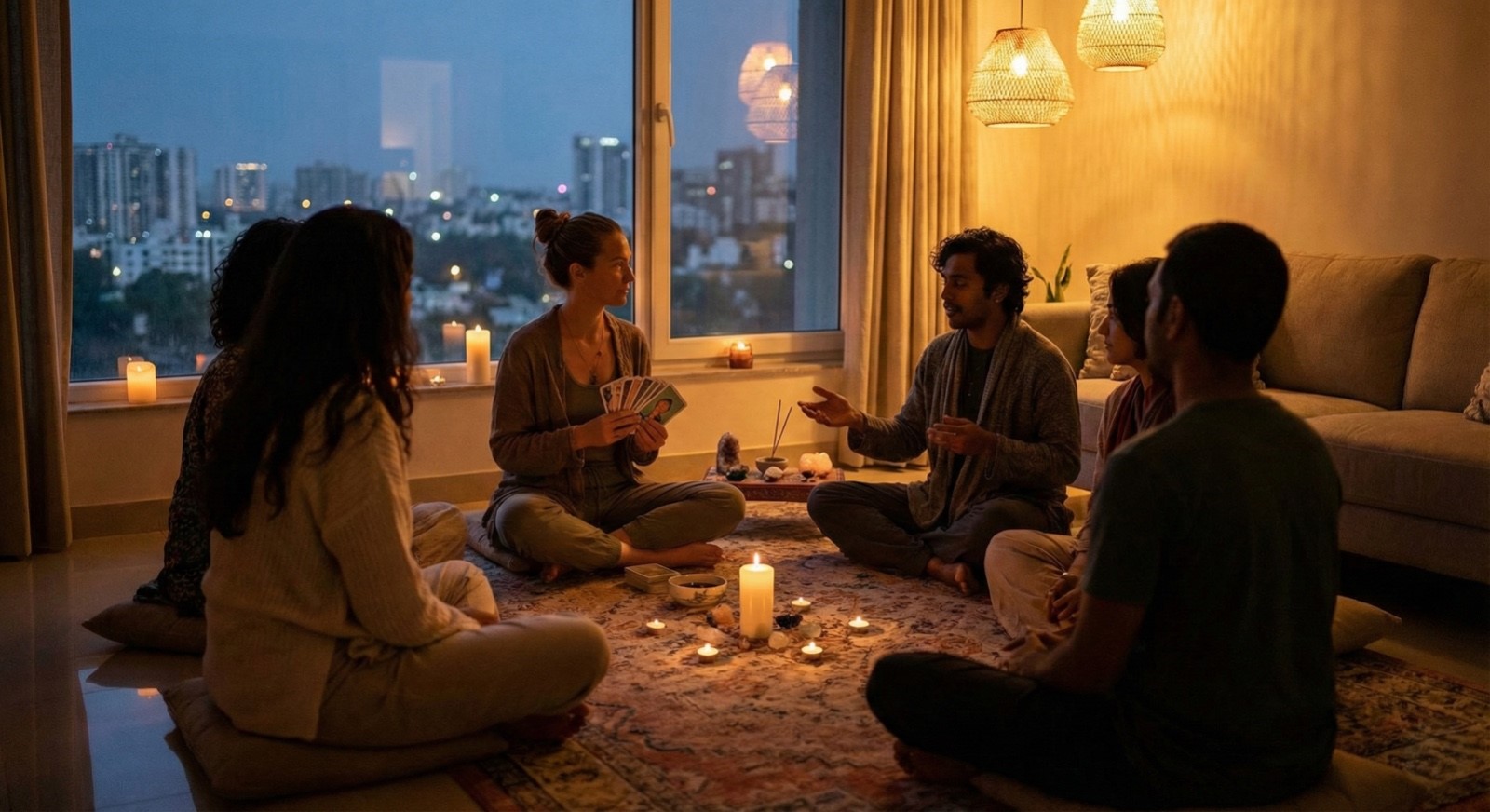
Walk into one of these evenings and nothing is accidental. A tarot gathering in Indiranagar might begin with the soft crackle of vinyl, the deep amber of low lighting, and the faint aroma of sandalwood mingling with jasmine. Notes are chosen as consciously as a perfumer chooses a base. Participants take their places around a hand-carved table, each position reflecting a symbolic orientation: north for grounding, west for release, east for new beginnings.
Every element serves a purpose. The cards themselves may be commissioned decks. Illustrated by local artists, bordered in gold leaf, weighted just enough to feel substantial when held. The reader’s voice flows with a practiced calm, transforming each spread into a narrative tapestry woven from archetype, memory, and possibility.
These sessions offer more than insight; they offer a container. A space carved out from the city’s noise, where the psyche stretches into shapes it rarely has room for. They’re as much art installations as they are spiritual practices, with participants stepping into a moment suspended outside the ordinary.
ASTROLOGY AS AN IMMERSIVE EXPERIENCE
Astrology, long a private language whispered between family and faith, has found new expression. Modern practitioners in Bengaluru are designing full-sensory astrological experiences that feel like stepping into one’s own celestial map.
A birth chart reading becomes a guided journey, where lights shift to mirror planetary alignments and music evolves in tandem with the narrative. Melodies brighten as Venus enters the frame, deepening as Saturn casts its long shadow. Some hosts incorporate bespoke fragrances, each note representing a ruling planet or elemental force. Others bring in chefs who craft tasting menus aligned to zodiac seasons: earthy textures for Taurus, shimmering citrus for Gemini, brooding spice for Scorpio.The result is a kind of cosmic theatre where astrology is not simply interpreted but embodied
ARTIST OR RITUAL PERFORMER
Then there are the ceremonial performances: evenings where a ritualist becomes a storyteller, choreographing emotion through movement, stillness, and intentional symbolism. These performers draw from ancient traditions but reframe them through a contemporary lens borrowing the minimalism of modern dance, the pacing of meditative practice, and the intimacy of one-on-one theatre.
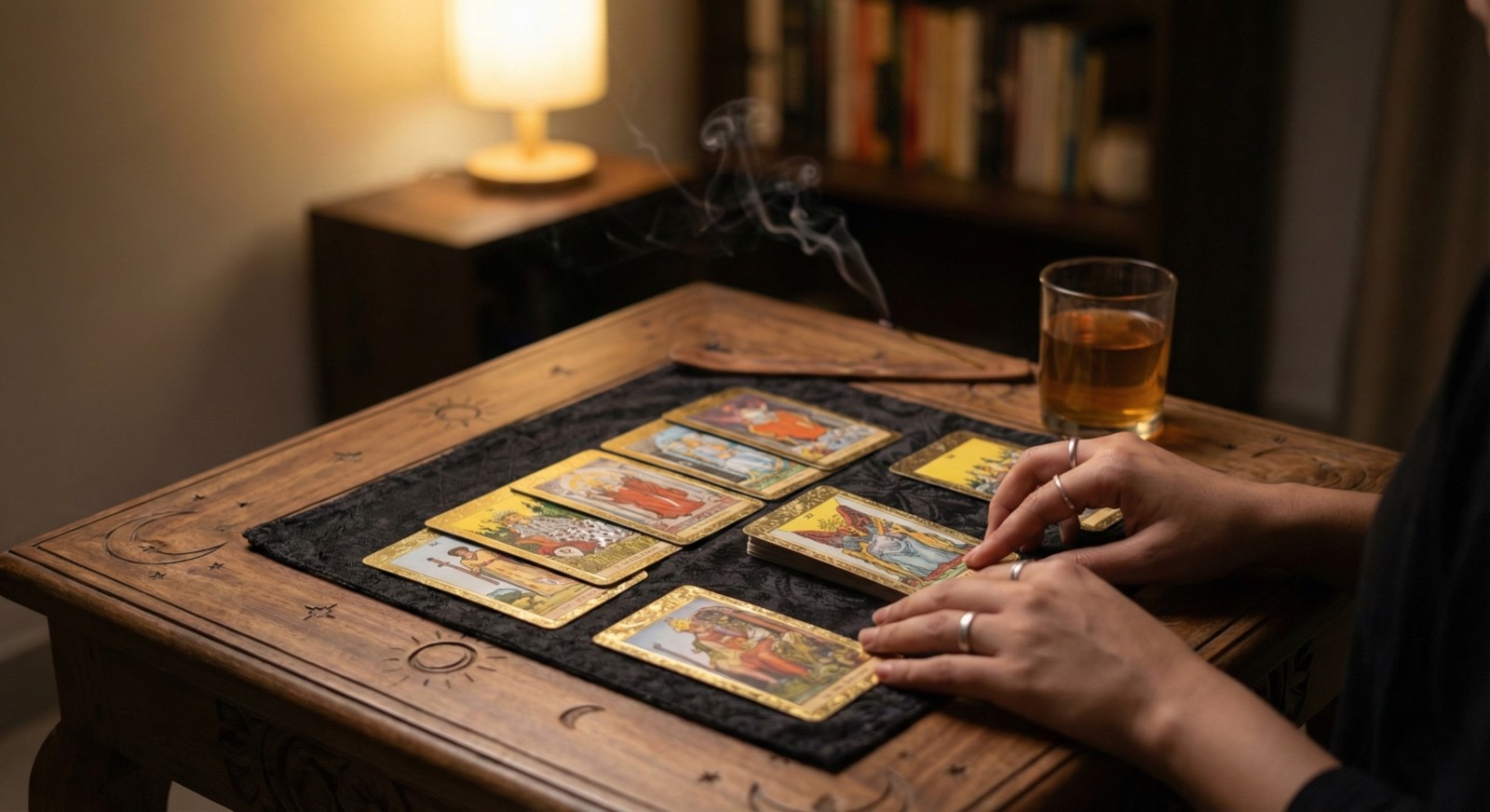
A performer may weave cloth, light incense, or trace patterns in ash, each gesture slow and deliberate. The room becomes a sanctuary where time loosens its grip. Participants are invited to witness rather than participate, and yet the effect is profoundly personal, like discovering an internal landscape through someone else’s measured breath.
These rituals aren’t about belief; they’re about the encounter. The impact lingers not because of any promised transformation, but because such intentionality, such slowness, is rare in a world built on acceleration.
THE CONTEMPORARY SHAMANIC PRESENCE
Alongside these experiences, a quieter yet compelling figure has begun to surface in Bengaluru’s spiritual landscape: the modern shaman. No longer the distant mystic of folklore, today’s shamanic practitioners operate with a sensitivity that feels almost architectural. These spiritual artistes concoct the inner journeys of their audience with the same care one might devote to an exquisite piece of art.
Their sessions rarely resemble anything theatrical. A shaman guides participants through visualizations that mimic a descent into and a subsequent emergence from a quieter more personal undertone, that the rush of life does not often permit us to see, or through grounding rituals that reconnect the body to an interior compass too often lost in the velocity of the city’s buzz.
These encounters often feel like stepping into a temporary suspension of the city’s ceaseless mental hum. It is the way in which a shaman modulates silence, opens emotional thresholds, or invites a single moment of stillness that feels hand-carved, that makes the experience an example of a moment of the utmost peace, nestled in the cocoon of the prosaic day-to-day.
Within Bengaluru’s evolving vocabulary of spiritual refinement, the shaman becomes less a mystical authority and more a curator of inwardness. Their work does not demand belief. Instead, it offers an experience which is simultaneously intimate and atmospheric, and tuned to frequencies that modern life rarely allows us to hear.
SPIRITUALITY AS FASHION
Spirituality is also unmistakably influencing the way Bengaluru dresses. Wardrobes once confined to a set selection; either crisp attire for formal affairs, or comfortable sets for use within the circle of home, now contain textured linens dyed in earthy palettes, jewellery inspired by planetary glyphs, handcrafted talismans worn not as statements but as companions of a faith that needs no words to feel felt or understood. Even makeup trends echo this sensibility: soft metallics reminiscent of moonlight, skin tints that glow like candlelit rooms, silhouettes that move with the body rather than constrict it. This is not just spirituality worn; it is fashion reborn. Each piece becomes a reminder of an inner world, an extension of one’s personal landscape. In a city like Bangalore where self-expression has always found inventive pathways, modern style is becoming another form of ritual—a way to carry the unseen into the everyday with grace and deliberation.
WHY BENGALURU, AND WHY NOW?
This shift toward curated spirituality is emerging at a moment when the city stands on a cultural precipice. Technology has given Bengaluru global reach, but it has also heightened its appetite for nuance, for experiences that counter the hyper-digital with something tactile, sensory, and rooted.
For many, these practices become a way to reclaim interiority, to carve moments of depth within the relentless churn of productivity. There is a growing recognition that meaning is not found only in acquisition or visibility; it is found in the quality of one’s attention, in the worlds one chooses to build behind closed doors.
And so, private spiritual practices have become less about answers and more about atmosphere, the kind of setting where one can finally hear thoughts that otherwise dissolve into the noise of the everyday.
A NEW LANGUAGE OF REFINEMENT
What’s emerging is not a trend but a cultural recalibration. Spirituality in Bengaluru today is intertwined with taste, but not in a performative way. It reflects a desire for experiences that feel intimate, rare, and emotionally resonant. A beautifully arranged tarot table, a ritualist’s whispered invocation, a candle flickering against textured walls become touchpoints of personal expression.
The city’s most thoughtful residents are not simply participating in these practices; they are commissioning them, shaping them, and elevating them into art. In doing so, they redefine what it means to live well, not through opulence or excess, but through depth, intentionality, and the quiet pursuit of wonder.
Here, refinement is no longer about the spectacle of luxury. It lives in the smallest, most carefully curated gestures; in the way light falls across a room, in the sound that precedes a reading, in the stillness between two breaths where something wordless but unmistakably powerful stirs.
In Bengaluru, the unseen is no longer peripheral. It has become a cornerstone of modern living: a private, poetic ritual that reflects who we are becoming more thoughtful, more sensory, more attuned to the delicate spaces within ourselves.
Author